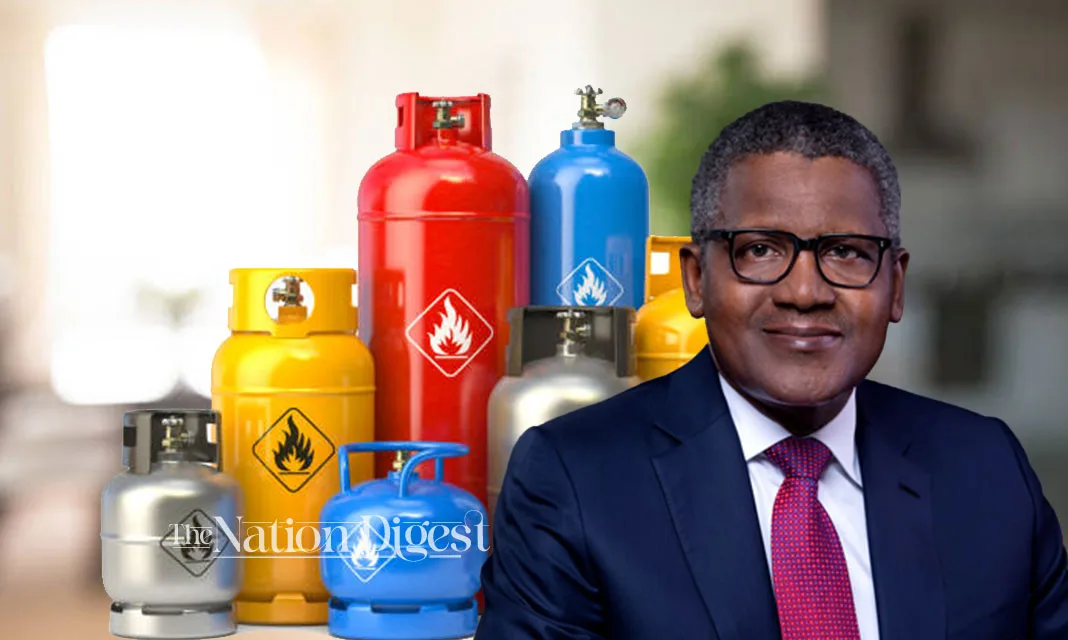
Alhaji Aliko Dangote, President of the Dangote Group has announced his refinery’s plan to crash the price of cooking gas in Nigeria, for households still cooking with firewood or kerosene, this sounded like salvation. But behind the billionaire’s good intentions, not everyone is clapping. Some believe that the plan, noble as it appears, could carry deeper consequences.
Dangote’s refinery, now producing 22,000 tonnes of Liquefied Petroleum Gas (LPG) daily, is a big deal. Speaking to business leaders at the Lagos Business School CGEO Africa forum, he noted that Nigerians are gradually transitioning to LPG. Yet, he added, the current price of cooking gas in Nigeria remains too high for ordinary people. “We’re trying to bring down the price and make it cheaper,” he said. And if the distributors refuse to comply, Dangote threatens to sell directly to the consumers.
It’s a move that has made many Nigerians cheer especially on social media. @paynedre1 wrote,
“If Dangote follows through with direct sales, it will not only crash the price of cooking gas but also force transparency and competition.” Another user, @BrotherAghama, went as far as saying that those against the move are “masquerading as marketers” trying to “reap the masses.”
But is it that simple?
The Monopoly Question
As expected, industry players are pushing back. They argue that Dangote’s plan might not just be about cheaper prices it could be about controlling the entire market.
Godwin Okoduwa, former Chairman of the LPG and Natural Gas Downstream Group of the Lagos Chamber of Commerce, didn’t mince words. “It’s monopolistic,” he told the press. “The LPG industry in Nigeria grew from 70,000 metric tonnes in 2007 to over 1.3 million tonnes in 2022. That was done by collaboration not dominance.”
He believes that while Dangote’s refinery has the scale, the strategy should focus on expanding access rather than erasing the current players. “He should respect the market and let us grow. It shouldn’t be a zero-sum strategy,” Okoduwa insisted.
Others in the sector share this concern. Bassey Essien, Executive Secretary of the Nigerian Association of Liquefied Petroleum Gas Marketers, even questioned the feasibility of the plan.
“It’s unrealistic,” he said. “Has the refinery been able to sell petrol directly to you and me at a cheap rate?”
Critics worry that while the immediate drop in the price of cooking gas in Nigeria might look good, a monopoly could follow. And monopolies, as history has shown, eventually hurt consumers with price hikes, restricted supply, and zero competition.
Social media hasn’t ignored this point either. @Ajibade74 warned,
“Dangote has a well-documented history of resisting competition… Once he becomes the sole player, prices can be manipulated without resistance.
” Another user, @kelvin_chike, added,
“He has actually never brought any price of things down, even when he sells them at scale.”
The concern is clear: will this crash be temporary, only to be followed by a long, painful rise?
Also Read: Court Rules Against NNPCL in Dangote’s Import License Case
Middlemen or Market Messiahs?
To understand why this debate is even happening, you have to consider how gas pricing works in Nigeria. A large part of the cost comes from the network of middlemen, distributors, transporters, and retailers all adding margins. Dangote’s idea to sell directly cuts through this chain, which some say is the root of the problem.
Supporters of Dangote argue that it’s about time someone shook up the system. @Jonehmk posted,
“Those distributors are the middle men that cause the price hike.” Another comment by @GabrielOla64 noted, “Now that the price can go down and make it cheaper for the people, we want to continue making outrageous profits?”
For these voices, Dangote’s intervention is not just welcome, it’s long overdue. “We owe the almost 30% drop in LPG prices over the last 7 months to the refinery,” @BIwajomo said, speaking as someone within the industry.
Clearly, there’s a perception that the price of cooking gas in Nigeria has long been manipulated by entrenched interests. And Dangote’s threat to go direct is seen by some as a form of market justice. But is bypassing the middlemen a sustainable solution? Or will it cause more harm by destabilizing those who have invested in building the distribution network?
Balancing Public Good with Private Power
At the heart of this debate is a much bigger question: can one man no matter how rich or powerful be trusted to unilaterally reshape a sector that affects millions of Nigerians?
Let’s be fair, Dangote has the capacity to influence pricing positively. His refinery has already shifted dynamics in diesel and fuel markets. But fuel is not food, and gas isn’t just about affordability. It’s about access, infrastructure, and policy.
Experts like Okoduwa have rightly pointed out that while LPG production has grown, Nigeria still lags behind countries like Morocco and South Africa in per capita usage. “We can do much more,” he said. “He should work towards collaboration, not competition.” He even suggested that Dangote invest in the under-served Northeast to build infrastructure and grow demand.
And he has a point. Real reform comes when everyone wins: the producer, the distributor, and most importantly, the consumer.
If Dangote truly wants to bring down the price of cooking gas in Nigeria, then collaboration might achieve more than confrontation.
Final Thoughts: A Choice Between Savings and System Stability
Dangote’s plan, whether driven by market compassion or business ambition, has put the price of cooking gas in Nigeria at the center of a much-needed national conversation. And rightly so. Every Nigerian deserves access to affordable, clean cooking fuel. It’s not just about convenience; it’s about health, dignity, and economic justice.
But as the saying goes, the road to hell is sometimes paved with good intentions. If the drive to crash prices ends up killing competition and creating dependency on one source, the very people meant to be helped may suffer in the long run.
Yes, Nigeria needs bold moves. But it also needs checks and balances. If Dangote’s strategy truly focuses on the people, then he must bring everyone to the table not clear it entirely.
Let’s keep our eyes open, not just for cheaper gas, but for a fairer, more transparent market. After all, monopolies might crash prices today but they could raise them tomorrow when there’s no one left to challenge them.
What do you think?
Has your household felt any relief in cooking gas prices recently? Share your thoughts and stories in the comments — your voice matters.